Monday get organized. Tuesday get some momentum. Wednesday ... maybe just a moment of wondering, before losing yourself entirely to the week?
Sunday, 29 March 2020
Angels rush in ... (Day 4 of 10 Days of Gratitude)
Within less than three minutes of making the call, the ambulance had arrived and was parked in front of the house. After unloading and readying the stretcher on the sidewalk in front of the house, two paramedics came in the front door. With gloves on and no masks they asked a few questions about our possible exposure to COVID-19 (the same questions that had been asked earlier by the (911 operator), but you also knew from their demeanour that no matter what the answer they were going to be in the bedroom to tend to Japhia without delay.
Instant sympathy and rapport. Immediate analysis of the problem. Bending to the patient's wish not to have to go to the ER given the pandemic and the risks associated with it, they gave total and careful attention to what treatment they could offer where they and we were.
In ten minutes they had resolved the worst of the symptoms of the chronic disorder that had flared up. They gave advice and direction for the next few days. They shared a bit of their own life story. I think they as much as we appreciated the chance for human contact.
Again they asked Japhia if she was sure she didn't want to go in to the ER. They assured us she would probably sleep through the night, and be the better for it. They told us to call back if needed -- that they were just a few minutes away.
Then they packed up, cleaned up and were on their way. Back to the station to wait for other calls until their shift would be over around sunrise.
And really, this is only usual paramedic service. But the times we are in -- this time of pandemic, makes it much more than "just usual."
How can we not be thankful for paramedics who serve the well-being of others like this in a time like this?
The day after this event the local paper told a story of how paramedics far more than firefighters and police officers are now suffering massively increased instances and degrees of PTSD.
I wonder. In addition to other stresses, could there be a connection between that and the fact that while these two came in as they did, three firefighters who followed the ambulance to our house stayed outside having to chat among themselves through protective masks, under instruction not to enter the house without the paramedics going in first, establishing the parameters of the scene, and asking for their assistance only if needed?
I am immensely grateful for those two paramedics who Friday night just came right in where others cannot or will not tread.
Friday, 27 March 2020
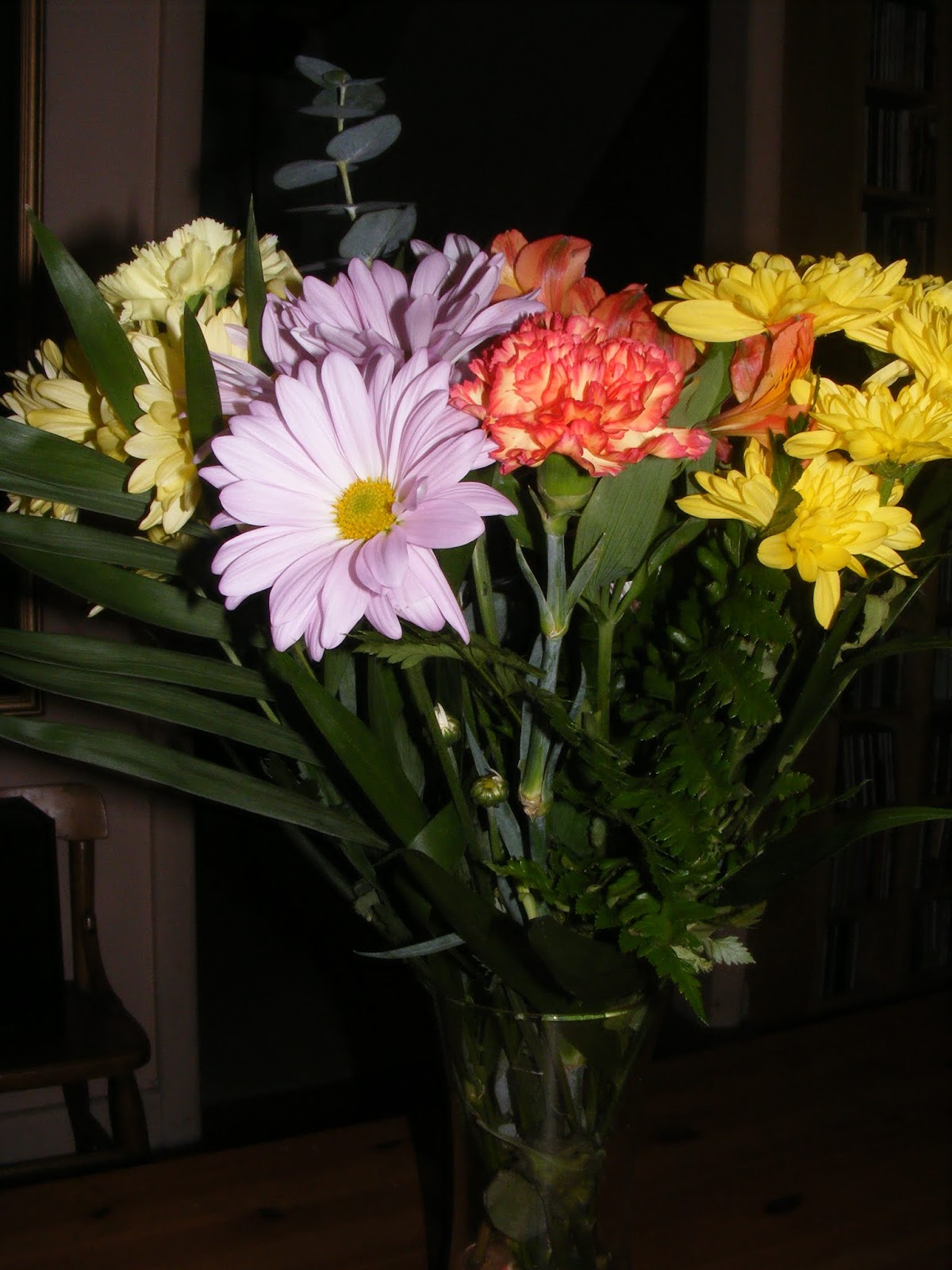
Still Life (Day 3 of 10 Days of Gratitude)
Still vibrant.
For how much longer, though?
They were bought and brought home maybe a week ago. Or longer. How many days before that were they cut off from their roots?
How much longer can they last?
And is this not the way of all flesh? The moment we are born -- the moment the cord is cut, they say, we begin our dying.
But look how long we are vibrant. How long we vibrate with the pulse of life. Pulse the heartbeat of God. Unfold, open and offer -- each of us, our own flowering of God's glory.
I like what Richard Rohr (or was it Diana Butler Bass?) says about each of us and every other creature and created thing being a unique and singular emergence in time of some element or aspect of the Divine, at once eternal and transient. I like the way Leonard Cohen puts it, that we are "really nothing but the brief elaboration of a tune." (Nothing but ... but is there anything more or grander than this humble service?)
I am grateful.
For the flowers in their brief time. For what they are, and what they show me of something more.
For my life and yours and all life vibrating both now and forever with the purpose and pulse of God.
Wednesday, 25 March 2020
Living in the Web .. old-school style (Day 2 of 10 Days of Gratitude)
Today is my sister Valerie's birthday. Happy birthday, Val!
I have to send a card. (Yes, I know I'm late! You think I don't know that?)
But I didn't know their mailing address. I know where their house is and how to get there, but can't visualize the number by the front door.
Google it? Call and ask for her husband Jim, so I don't have to admit to Val in person how late her card will be?
Normally we get together for an evening of birthday appetizers and euchre, and the card is hand-presented. A wonderful system that's worked for decades.
So with the breakdown of what we're used to, I revert to what used to be. The even older system. I phone my other sister Carol to get Val's address.
As kids it was Carol who always knew our parents' birthdays and anniversaries, would buy the card, and bring it to Val and I to sign. As we grew older and moved out and on it was Carol who without fail would remember the day and send a card well in advance. Also Carol who kept a list of special days for all the aunts and uncles and cousins all over the country.
Well before the Web, Carol was the family spider spinning faithful lines of caring connection among us all.
I obviously was not as good at it, nor committed to it. At times even resistant to it. At other times, just forgetful about it.
But I'm grateful the web still holds. That this old-school network of family connectedness and care has withstood the tests of time.
Now that I have the address, as soon as I get it in the mail, and then a little after that, Val will know I remembered to buy her a card.
Two, in fact.
Because I'm grateful.
(And ... there goes the suspense and surprise for Valerie! Good thing she loves me. Which I am also grateful for.)
Tuesday, 24 March 2020
Awakening to Gratitude (Day 1 of 10 Days of Gratitude)
I
think there's such a thing as "a month of Sundays" (or is it Mondays?);
how about "ten days of Wednesdays"? A lot of folks have taken up the
online challenge of posting 10 days of pictures of things they are
grateful for. Because I love to write (hear myself talk?) I'm accepting
the challenge in this media. Remains to be seen if I manage ten days
in a row -- either of being grateful, or of blogging about it.
I was awake -- mind going full throttle, at 2:30 this morning. I used to resent this; I've grown now to treasure these times of waking up to the dark. (Especially after reading a book by almost that exact title)
Downstairs I briefly checked the 24/7 Coronavirus Pandemic news on The National. Nothing yet about the federal government invoking the Emergency Measures Act.
On BBC Earth I watched the last few minutes of a show about searching for the smallest particle in the universe. Then the first few minutes of another show about searching for life on planets in other universes. And noticed that BBCE's schedule for later in the day includes a whole string of episodes of a show about nature's "weirdest events."
Is reality these days only emergencies and extremities?
I shut off the TV and went to look out the back door.
There lay the familiar bend in the street, the houses and driveways all along one side of it, the parkette and playground across the road and at the heart of it all. A still, silent scene emptied of human life under the sentinel streetlight. Abandoned and forsaken, deserted, just as it is now in the sunlight of cold day as well in this time of social distancing and self-isolation.
I walked to the front door. Looked out just to see.
And there on our front lawn was a rabbit.
Brown.
Warm brown.
Living.
Quietly moving.
Confidently and soundlessly nibbling at a particular very little patch of weedy grass of some kind right by the sidewalk, that grows up taller and thicker every year than the rest of the lawn. That I've not bothered to get rid of. Nor learn the name of. That this gentle, dear rabbit seems very familiar with and accustomed to. Maybe thankful for, as much as an animal feels thanks.
An Easter rabbit, of a race deeper than Cadbury's? I have begun to wonder how on Earth we will mark and celebrate Easter this year.
As soundlessly as him (or her? how would I know?) I moved full onto our closed-in front porch to be able to see it all the clearer and closer. Standing still in pre-dawn cold I watched the rabbit graze the front lawn for maybe two minutes before disappearing from my sight into the shadows that lay across our neighbour's lawn.
Life persists. Warm brown. Gently confident. Bold even, for something so precious and vulnerable. Moving, in more ways than one.
I returned to the dark of the bedroom and of rest.
Grateful.
I was awake -- mind going full throttle, at 2:30 this morning. I used to resent this; I've grown now to treasure these times of waking up to the dark. (Especially after reading a book by almost that exact title)
Downstairs I briefly checked the 24/7 Coronavirus Pandemic news on The National. Nothing yet about the federal government invoking the Emergency Measures Act.
On BBC Earth I watched the last few minutes of a show about searching for the smallest particle in the universe. Then the first few minutes of another show about searching for life on planets in other universes. And noticed that BBCE's schedule for later in the day includes a whole string of episodes of a show about nature's "weirdest events."
Is reality these days only emergencies and extremities?
I shut off the TV and went to look out the back door.
There lay the familiar bend in the street, the houses and driveways all along one side of it, the parkette and playground across the road and at the heart of it all. A still, silent scene emptied of human life under the sentinel streetlight. Abandoned and forsaken, deserted, just as it is now in the sunlight of cold day as well in this time of social distancing and self-isolation.
I walked to the front door. Looked out just to see.
And there on our front lawn was a rabbit.
Brown.
Warm brown.
Living.
Quietly moving.
Confidently and soundlessly nibbling at a particular very little patch of weedy grass of some kind right by the sidewalk, that grows up taller and thicker every year than the rest of the lawn. That I've not bothered to get rid of. Nor learn the name of. That this gentle, dear rabbit seems very familiar with and accustomed to. Maybe thankful for, as much as an animal feels thanks.
An Easter rabbit, of a race deeper than Cadbury's? I have begun to wonder how on Earth we will mark and celebrate Easter this year.
As soundlessly as him (or her? how would I know?) I moved full onto our closed-in front porch to be able to see it all the clearer and closer. Standing still in pre-dawn cold I watched the rabbit graze the front lawn for maybe two minutes before disappearing from my sight into the shadows that lay across our neighbour's lawn.
Life persists. Warm brown. Gently confident. Bold even, for something so precious and vulnerable. Moving, in more ways than one.
I returned to the dark of the bedroom and of rest.
Grateful.
Monday, 30 December 2019
Happy new year. How might it be?
Announcement to the Shepherds by (Abraham Bloemaert, ca. 1600)
Today isn't Wednesday. But it's Wednesday I'm wondering about today.
Jan 1, 2020. Happy new year!
And I wonder what makes a year good? What are we really wishing one another when we say, "Happy New Year"?
One card we received this Christmas put it this way: "may the best of 2019 be the worst of 2020."
How great that would be! I appreciate the sentiment. And the sympathy it shows among our friends for the hard bits we suffered this past year.
But is that how life goes? Especially as our bodies age and weaken? As our spirits remain sensitive to accumulated wounds of the past, and subject to unresolved anxieties about the future? And our memory has not failed quite enough yet to allow us to live in a blissful awareness only of the blessed present?
Is it realistic to wish for a life of successively only-happier and easier years, when we know that life -- neither ours nor God's, is like that?
But what then? Is the only other option a depressing Eyore-ish wish like, "Oh well, hope that 2020 won't be too bad for you ... hope you make it through ... if you can."
Is there maybe a middle way between -- or more accurately, a third way beyond optimistic dreaming and pessimistic dreariness?
Today I received in my email inbox this thought of Howard Thurmann (1899-1981), an African-American author, theologian, educator and civil rights leader. He says:
"There must be always remaining in every person's life some place for the singing of angels, some place for that which in itself is breathlessly beautiful and by an inherent prerogative, throwing all the rest of life into a new and creative relatedness, something that gathers up into itself all the freshets of experience from drab and commonplace areas of living, and glows in one bright light of penetrating beauty and meaning -- then passes.
"The commonplace is shot through with new glory; old burdens become lighter; deep and ancient wounds lose much of their old, old hurting. A crown is placed over our heads that for the rest of our lives we are trying to grow tall enough to wear. Despite all the crassness of life, despite all the hardness of life, despite all of the harsh discords of life, life is saved by the singing of angels."
Maybe the third way (usually the gospel way?) has something to do with ready and opened listening? A particular kind, and direction of listening. Intentional listening to what is both momentarily and eternally life-and-perception-and-possibility-and-reality-changingly beautiful.
I wonder, for instance, if Thurmann's thought helps me understand why I choose to listen at times to Philip Glass's Songs of Liquid Days, especially the last two songs that I find achingly and overwhelmingly beautiful -- David Byrne's "Open the Kingdom" sung by Douglas Perry, and Laurie Anderson's "Forgetting" played by the Kronos Quartette and sung by Linda Ronstadt backed by The Roches. I wonder -- as I listen, is life as it is, transformed for me, and am I, as I am, transformed for life?
And in how many varieties of ways, approaching us through how many more of our more-than-five senses, do the angels appear and "sing" to any of us -- sing to you, as and where you are, of the holiness and wholeness of life, just as it is?
And in how many ways, also, am I and are others blind, deaf and insensitive -- dulled by what we make and think of life, to the song the angels want to sing to us?
In the painting above of the announcement to the shepherds, for instance, how many are actually attending to, or even aware of the angels' song?
Thurmann, when he says "there must be .. in every person's life some place for the singing of angels" is not naive about the matter of angel's songs and life's transformation. His "must" is more a wake-up call to intentional awareness, than a statement of universal, inevitable experience.
"There must be always remaining in every person's life some place for the singing of angels, some place for that which in itself is breathlessly beautiful and by an inherent prerogative, throw[s] all the rest of life into a new and creative relatedness.... Despite all the crassness of life, despite all the hardness of life, despite all of the harsh discords of life, life is saved by the singing of angels."
So ...
Happy New Year! May the angels be with you. And may they sing to you as and where and when you need their song.
Tuesday, 5 November 2019
My name is Brian, and I am powerless.
On a personal level I have felt powerless during Japhia's two- and three-week-plus hospitalizations for a chronic disorder. I know you also have felt powerless in a variety of ways in your life -- maybe feel that way right now. On a larger scale, the terrible experience of powerlessness is also a force in many current political movements.
Being powerless is common to the human situation, and how we deal with it is important.
My first response usually is to try to gain more control. In other words, more power. When Japhia's disorder becomes so severe she is hospitalized, I google the illness. I ask the doctors and nurses as many questions as I can think of. Piece together the information I find. Identify likely patterns, causes and consequences so I can give advice, suggest next steps, lay out problems to be overcome and mistakes to be corrected. And ultimately fix it. That's definitely the first desire: to fix it. To be the one in and with power.
After that I usually get angry. I get angry (or 'just frustrated,' as I like to say) at Japhia for being sick, and make her feel like she's done something wrong. Get mad at pedestrians and other drivers on my way to and from the hospital, for things they do wrong. Vent my jealousy (or 'righteous indignation,' as I tell myself) at other people who seem to have it all together, and seem to be successful, privileged, fortunate. Truth is, I get angry. Because I feel a need to blame someone for the unfairness.
I also start to consume more than usual. In our society and culture being able to buy, to eat, to use, to own, to consume stuff in any way makes us feel good, important and ... yes, powerful. So every time I come in or go out of the hospital I buy a coffee and maybe a sourcream plain or a glazed cinnamon roll at the Tim's in the lobby (have you noticed my weight gain?), just because I can and because it makes me feel less powerless. During one of Japhia's two-week hospitalizations I bought a new stereo and used an afternoon when I said I was going home "to rest", to set it up. The next day I tried to resurrect and install an old turntable to make the system "complete." Many nights when I come home from an evening at the hospital, I eat and drink excessively, and binge-watch Netflix ("The Good Place") or listen to music for longer than I admit ("Radio Paradise"). And oh, how telling, those particular choices!
I cherish distractions. Like work can be at times like this. Or Jets' hockey. Or Blue Bombers' football.
And I live for moments of rest. Like driving through the dark streets of the city on my way home from St. Joe's. Especially that long, slow, eternally curving stretch of Cootes Drive just past the University and into Dundas. Troubles and concerns fall off and away into the ditch and into the darkness of Cootes Paradise as I gracefully steer my secure and speedy way home. A kind of momentary secular sabbath at 90 or 100 km/hr.
And I pray. Finally.
Not for miraculous supernatural healing. God forgive me if I'm wrong, but that kind of prayer feels to me like a return to response number one -- the desire to be in control and have the power to fix it (but this time, with God as my all-powerful helper to do my will) so we don't have to deal with things like bodily disorder, life-change and that whole whack of other things that comes with being human, imperfect, mortal and vulnerable.
I find myself drawn instead to the kind of prayer that Twelve-Step programs of spiritual recovery talk about -- the very simple and radically open-ended prayer for knowledge of God's will and the willingness to do it, the courage to live into it. I've no doubt healing of some kind is involved; but the healing of what? And how?
Which makes me wonder, when I think about all the ways we encounter powerlessness in life ...
... if maybe the question is not simply how we deal with powerlessness, as though it's something to be handled, attacked, tamed, wished away and resolved...
... but also how we live with powerlessness as something that's an inescapable, necessary, inevitable, God-blessed part of who we are, of what life is about, and of what drives us with a hard grace towards faith and trust in the journey we are on, as a journey with and into God towards our truest self.
Wednesday, 9 October 2019
If gratitude is the heart-beat of honest spirituality, do you know spiritual CPR?
I do not doubt gratitude is at the heart of human well-being. Personal well-being. And the well-being of the Earth.
Fear, anger, greed, grief, regret, guilt, anxiety, despair and a host of other negative emotions are all possible, and often reasonable and understandable responses to the events and circumstances of any given day. All of these feelings, though, when we give them power and let them control our heart and mind, and our relationships and actions, are antithetical to happiness -- both our own happiness and the happiness of others.
Gratitude, though, if we choose it as our spiritual home, our default mode, and our conscious base to which we always return, is key to our emotional and spiritual well-being, and our ability to live in ways that serve the well-being of others and of the Earth.
I wonder, though, how real gratitude is nurtured and maintained. The kind of gratitude that is not just a response to good fortune and blessing ("Gee, thanks! You shouldn't have. But I'm so glad you did! I'm really so blessed!), but is a choice to see and to celebrate the constant blessing in and of life itself, no matter what.
We all have heard or read stories of people who live with that kind of gratitude -- the cancer patient who lives with deep and joy-filled thanks for each day, a person who hits bottom and gives honest thanks for the landing, someone living in third-world poverty who at the drop of a hat shares and gives away all they have just for the joy of it.
I assume that's kind of what gratitude looks like.
I also know it's not always the story of me. Not what I see every day when I look in the mirror. More often than is good for me, what I see there are some of those other things. Yeah, I mean fear, anxiety, insecurity, lack of trust, anger ... do you really need me to name more?
So I wonder, if gratitude is the heart of real human being, of honest spirituality, and of sustained well-being for myself and others around me, what kind of CPR can I perform to kick-start my heart?
What do you do, if you ever feel a need to live a little more gratefully? What are some of your ways to revive your heart-beat of deep gratitude?
Subscribe to:
Comments (Atom)